Sustainable Knitwear Production in Peru

Introduction: A Natural Advantage for Sustainability
Sustainability in knitwear production is no longer a trend, it is a structural requirement for modern fashion brands. In this context, Peru has positioned itself as a global benchmark, not only for quality but for responsible production, making it a trusted sustainable knitwear manufacturer and ensuring that Peruvian knitwear meets the highest environmental and ethical standards. The country’s knitwear industry is built on a unique combination of natural fibers, ancestral knowledge, and increasingly transparent supply chains, making it a strategic partner for brands seeking long-term, sustainable value.
Sustainable knitwear production in Peru combines premium natural fibers, ethical labor practices, and traceable supply chains to deliver environmentally responsible and high-quality garments.
The Foundation: Sustainable Natural Fibers
At the core of sustainable knitwear production in Peru are its raw materials, particularly alpaca fiber and Pima cotton. Peru is home to approximately 87% of the world’s alpaca population, making it the leading global source of this premium fiber.
Alpaca is widely regarded as one of the most sustainable luxury fibers available. Its low environmental impact stems from efficient grazing habits, minimal water requirements, and a production process that does not rely on intensive chemical treatments.
Similarly, Peruvian Pima cotton is valued not only for its softness and durability but also for its compatibility with organic and regenerative farming practices, allowing brands to reduce their environmental footprint without compromising quality.
Sustainable fiber: A raw material produced with low environmental impact, minimal resource consumption, and responsible land use.
Context expansion:Emerging innovations such as Bioreactores are beginning to influence textile R&D globally, complementing natural fibers with lab-grown alternatives and reinforcing the shift toward more sustainable material ecosystems.
Ethical Production and Social Impact
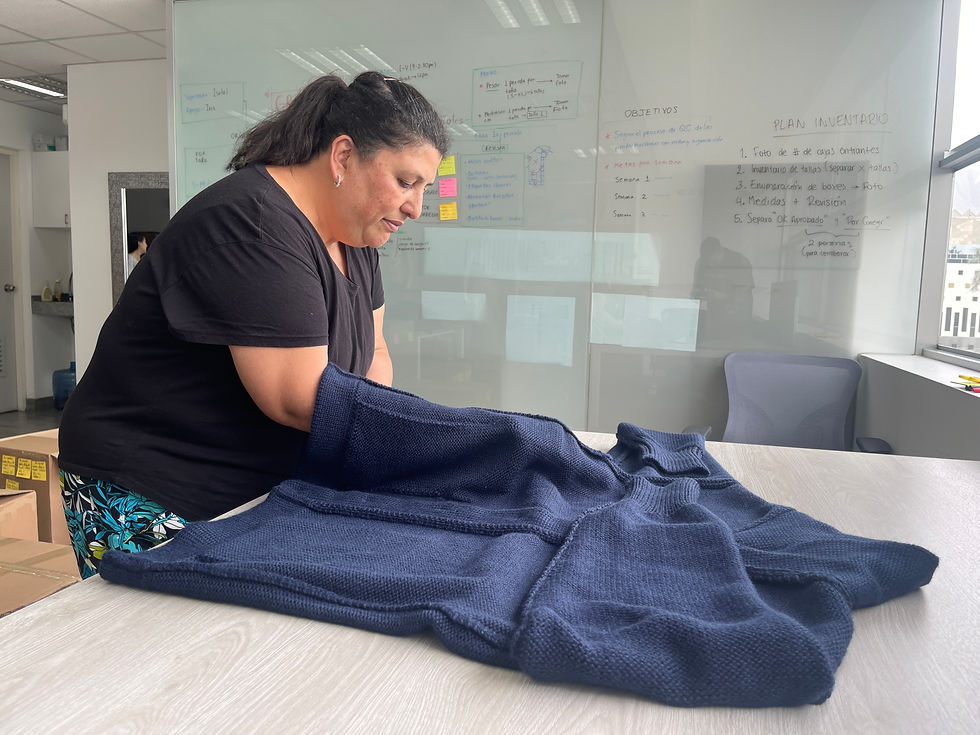
Sustainability in Peru goes beyond materials, it is deeply tied to people. The knitwear sector integrates artisan communities, knitwear specialists in Peru preserve techniques passed down through generations. This creates a production model where cultural heritage and economic development coexist.
Manufacturers and workshops often operate under fair trade or ethical frameworks, ensuring stable employment, especially for women and rural communities. In many cases, brands working in Peru actively support social inclusion and community development through their production networks.
Key Concept: Fair Trade Certified ensures that production meets strict social, environmental, and economic standards.
This human-centered approach transforms knitwear into more than a product, it becomes a vehicle for social sustainability.
Traceability and Transparent Supply Chains
Another defining characteristic of sustainable knitwear production in Peru is traceability. Many suppliers offer vertically integrated systems, allowing brands to track every stage, from fiber sourcing to final garment.
This level of transparency is critical in today’s market, where consumers and brands demand accountability. Companies working with organic cotton and alpaca increasingly adopt certified processes and long-term partnerships with farming communities, ensuring both quality control and environmental responsibility.
Traceability in knitwear means the ability to track a garment’s entire lifecycle, from raw fiber to finished product, ensuring transparency and accountability.
Technology layer: Digital tools such as Blockchain are increasingly used to verify supply chains, providing immutable records of sourcing and production.
Innovation Meets Tradition
Peru’s strength lies in its ability to merge artisanal techniques with modern manufacturing. From hand-knitting to industrial production, the country offers flexible systems that can adapt to different scales while maintaining sustainable standards.
Many manufacturers are implementing low-waste strategies to reduce overproduction , such as made-to-order production, small batch manufacturing, and the reuse of leftover yarns. These practices reduce overproduction, one of the fashion industry’s biggest environmental challenges, and align with circular economy and sustainable fashion principles.
Circular fashion: A system where materials are reused, recycled, or regenerated to minimize waste. Additionally, the integration of recycled materials into knitwear production is expanding, particularly in blends that maintain performance while reducing environmental impact.

Why It Matters for Global Brands
For fashion brands, sourcing sustainable knitwear from Peru offers a clear competitive advantage:
Access to premium, eco-friendly fibers
Ethical and transparent production processes
High craftsmanship with scalable capabilities
Strong storytelling rooted in culture and sustainability
Peru offers brands a combination of sustainability, traceability, and craftsmanship that supports both ESG goals and premium product positioning.
Global brands such as Patagonia and Eileen Fisher have set benchmarks by integrating traceable fibers and ethical sourcing models, reinforcing the value of transparent supply chains similar to those found in Peru.
KnitLab Peru: Connecting Sustainability with Production
In this ecosystem, KnitLab Peru plays a key role as a bridge between international brands and local manufacturing capabilities. By working closely with trusted suppliers, artisans, and vertically integrated factories, KnitLab ensures that each project aligns with sustainable production standards, from material sourcing to final delivery.
More than a sourcing partner, KnitLab Peru enables brands to develop knitwear collections that are not only high-quality, but also ethically made, traceable, and aligned with the future of fashion.
KnitLab Peru connects global brands with a fully integrated, ethical, and transparent knitwear ecosystem in Peru.

Article reviewed by Grace Wouters Huamanchumo, co-founder of Knit-Lab Peru and international knitwear industry specialist with over 10 years of experience working with fashion brands across the U.S., Europe, and Australia. Her expertise in sustainable manufacturing, strategic sourcing, and Fair Trade practices ensures the accuracy and relevance of the content published on this site.